Every AI agent framework racing to production in 2026 – LangChain, LangGraph, CrewAI, AutoGen, the OpenAI Agents SDK, Google’s Agent Development Kit – was built Python-first. That is not a coincidence of timing. It is the continuation of a fifteen-year pattern in which one language kept winning the fight for developer attention in artificial intelligence, and it explains why Python is now the single most valuable skill on an AI/ML hiring wishlist.
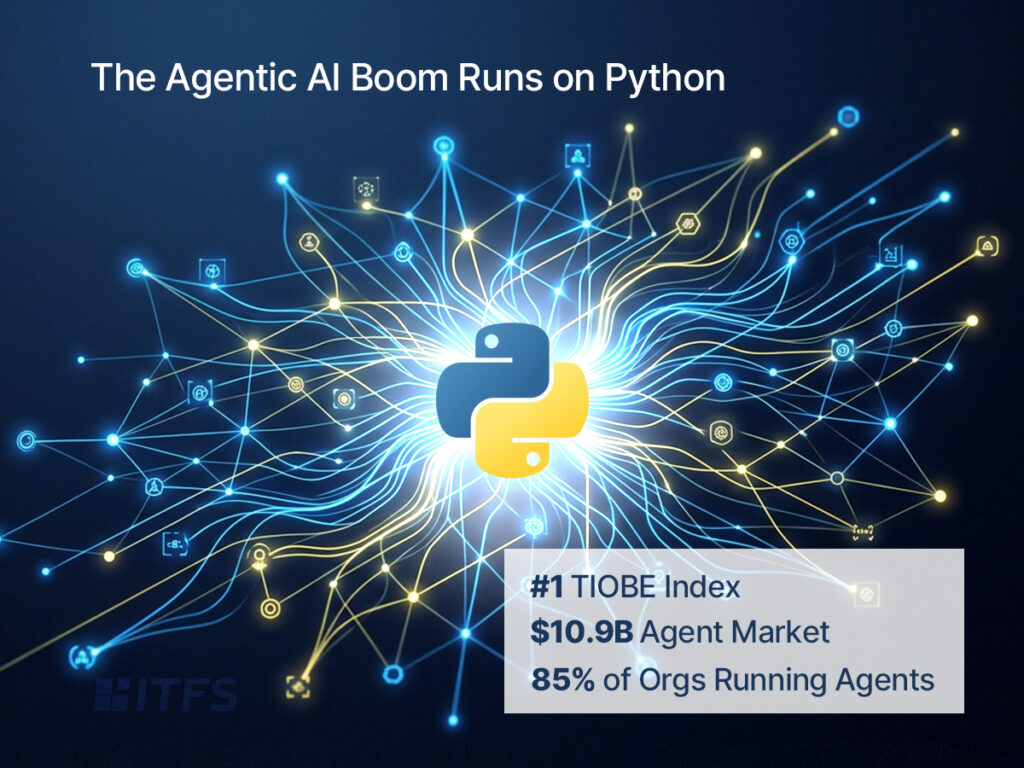
The global AI agent market is on track to grow from roughly $7.6 billion in 2025 to nearly $11 billion in 2026, with 85% of organizations already running agents in at least one workflow. Multi-agent deployments inside enterprises grew 327% in under four months this year alone. Almost none of that growth would exist without the language underneath it.
Why Python, and Why Now
Python has topped the TIOBE Index and powered an estimated 70% of machine learning projects for years, long before “AI agents” became a boardroom phrase. What changed in 2025 and 2026 is what Python is being asked to do. Instead of training static models, teams are now building systems that plan, call tools, retain memory, and take autonomous action – and every framework built for that job launched in Python before it launched anywhere else.
LangChain alone has crossed 130,000 GitHub stars and 130 million downloads across its packages. LangGraph, its production-grade orchestration layer, reached general availability in October 2025 and is now the reference architecture behind agent deployments at Klarna, Uber, LinkedIn, BlackRock, and JPMorgan – the last of which now runs more than 450 agentic AI use cases in daily production. Klarna’s own agent handled 2.3 million customer conversations in its first month live, cutting resolution time from 11 minutes to under two. None of it required switching languages between prototype and production.
Need Python developers to build or scale your AI agent stack?
The Technical Case: Fast to Write, Fast Enough to Run
Python’s advantage was never really about raw speed – it was about the gap between an idea and a working prototype. The computationally heavy parts of the Python AI stack, from NumPy to PyTorch, are written in optimized C or C++ under the hood, so developers get near-native performance for the math while keeping a syntax simple enough to rewrite an agent’s reasoning loop in minutes rather than days.
That trade-off matters more for agents than it ever did for traditional models. An agent isn’t a single prediction – it’s a loop of tool calls, memory lookups, and re-planning that teams tune constantly as they learn what actually works in production. In most real deployments, the bottleneck isn’t Python’s execution speed anyway; it’s the several seconds spent waiting on the underlying language model’s response, which flattens any performance gap between frameworks almost entirely.
Where Python Isn’t the Whole Answer
A honest technical case for Python has to include its limits. Independent 2026 benchmarks show that agent frameworks built in Rust can deliver significantly higher throughput under heavy load than their Python equivalents – a real consideration for teams running agent loops at extreme scale. Organizations already standardized on .NET and Azure often get more value from Microsoft’s Semantic Kernel and its native C# support than from bolting Python onto an existing enterprise stack. And the infrastructure surrounding an agent – the APIs, queues, and gateways it runs on – is frequently written in Go or Rust for the same performance reasons that made Go the backbone of cloud-native computing. Python typically owns the agent’s reasoning; compiled languages often own the plumbing underneath it.
What It Means for Hiring
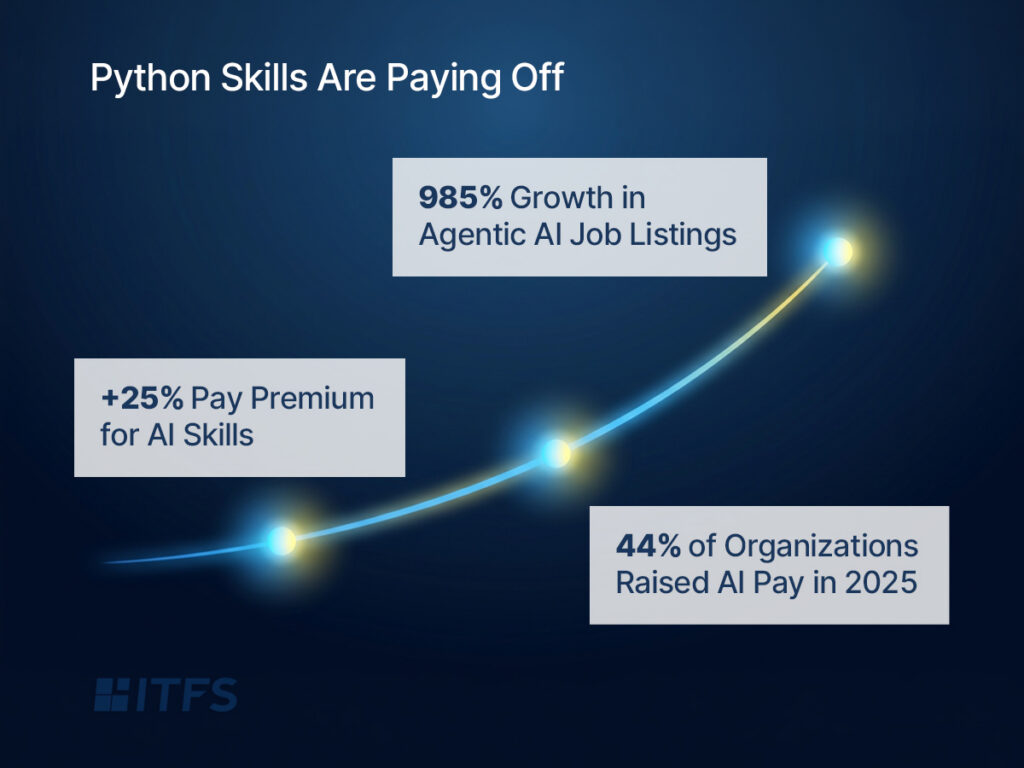
The practical consequence of Python’s dominance is a hiring market that has gotten measurably tighter, everywhere at once. Job listings for agentic AI roles jumped 985% in a single year as demand outran the supply of qualified candidates, and roles requiring AI skills now command up to 25% more pay than otherwise identical tech positions without them. Compensation for LLM application development specifically has grown roughly 25% since 2024, and 44% of organizations raised pay for AI-related skills in 2025 alone to stay competitive.
Entirely new job titles have emerged around this skill set in the past two years: AI Agent Developer, LangChain Developer, and AI Automation Engineer are now standard listings at companies building agent capabilities, and demand is concentrated in exactly this Python-based orchestration layer rather than in narrow model-training roles.
The Bottom Line
Python’s grip on agentic AI isn’t sentimental attachment to an old favorite – it is the result of every major lab and every popular framework independently reaching the same conclusion about which language lets teams move fastest from idea to production. As the agent ecosystem matures beyond prototypes into durable infrastructure, that head start keeps compounding: more integrations, more production references, and a larger, more experienced talent pool than any competing language can currently match.
Building an AI Agent Team?
Whether you need one specialist to prototype your first agent or a full team to take a multi-agent workflow into production, Python remains the language every major framework and every leading AI lab builds on first – and the fastest path to finding developers who already know that stack.
Looking for Python and AI/ML Expertise?
At ITFS, we connect companies with experienced Python and AI/ML engineers who bring hands-on experience with LangChain, LangGraph, and the wider agent ecosystem, along with the MLOps discipline needed to keep those systems reliable in production.
#ITFS #Python #AIAgents #AgenticAI #LLM #MachineLearning #ArtificialIntelligence #LangChain #LangGraph #MLOps #TechTalent #ITOutsourcing #AIEngineering #EnterpriseAI #PythonDevelopers #TechRecruitment
Sources
- TIOBE Index (2026)
- Stack Overflow Developer Survey 2025
- LangChain: State of AI Agents Report (2025-2026)
- Databricks: 2026 State of AI Agents Report
- InsightMark Research: LLM Agent Statistics 2026
- DEV Community: Benchmarking AI Agent Frameworks in 2026
- AI Monk: 12 Agentic AI Examples With Measurable ROI (2025-2026)
- Alcor: AI Developer Salary by Country (2026)
- Index.dev: 8 AI Developer Salary Trends to Watch in 2026
- eMasterLabs: AI Developer Salaries 2026
The language developers reach for fastest is rarely the fastest language – it’s the one that gets out of the way of their thinking. In 2026, that language is still Python.